

The Value Behind TCO
Total Cost of Ownership Explained
Is TCO on your mind? Well, it should be! Growth means investing into new infrastructure and automated systems to optimize your expansion. Analyzing Total Cost of Ownership or TCO metrics is by far the best way to ensure your business’ assets and finances are well managed. Managers often find themselves persuaded by “bargin” machinery but looking at all angles of an important purchase is paramount to determining all direct & indirect costs that may arise from the first day until it’s last. TCO paints a clearer picture of the positive or negative impact the machinery will truly have on their company. It will also provide the framework necessary to calculate ROI.
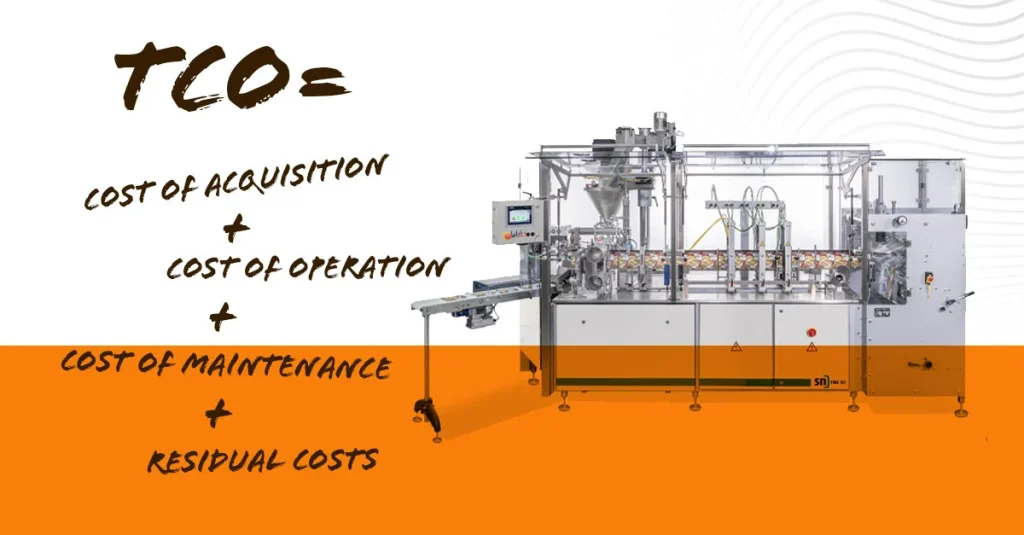
Bill Kirwin, an analyst at Gartner, an American consulting and research company, is credited with creating the concept. He defines TCO as “the total cost of acquiring, using, managing and withdrawing an asset over its entire life cycle”. Total Cost of ownership considers CAPEX, OPEX & OEE. Here is a breakdown of each element:
Capex – Capital Expenditure Cost
Capex considers the cost for engineering, Initial investment, commissioning, and start-up costs. These upfront numbers rarely tell the whole story — installation, system integration, training, and changeover costs often outweigh the sticker price itself. For a full breakdown of what most manufacturers miss, see our guide on what it really takes to prepare for automation.
Opex – Operational Expenditure Costs
This is where most manufacturers underestimate the math. Maintenance, sanitation, downtime, changeovers, energy, and packaging material consumption all belong here, but so does product giveaway, and it’s often the single biggest number on the list.
If your filler, scale, or counter is even slightly imprecise, those few extra grams per package add up fast. Take your average overfill per package, multiply it by your annual volume, then multiply that by your cost per kilo. The total is frequently large enough to justify the entire cost of an automated solution on its own.
Labour is the other overlooked OPEX line. Rapid hiring to keep up with growth often comes with agency fees, higher turnover, more rework, and more mistakes. Costs that never show up on a capital budget line but hit your margin just as hard.
OEE – Overall Equipment Effectiveness
A calculation of expected vs actual production rates. The formula includes Availability, Performance and Quality OEE=AxPxQ.
The fastest way to spot where you’re losing OEE isn’t a spreadsheet though, it’s walking your own line for a full shift and watching where it stalls. Running overtime or weekend shifts just to catch up is usually the bottleneck telling you exactly where it hurts. That’s not “just how it’s always been,” it’s a direct hit to your Availability number, and often the clearest signal of where automation will pay off first.
If your OEE is being pulled down by something you can’t quite pin on the machine itself, the gap is usually in the handoffs between steps, not the equipment. A line audit with our technical service team is a good first stop.
Why Packaging Industry Decision Makers are Using TCO
Take for example a chocolate manufacturer who is considering a hefty purchase – a new bagging machine. Packaging machinery comes with an impressive price tag and his first instinct may be to seek out used models that seem wise upfront but that would most likely cause many additional expenses, and headaches in the long run!
Here’s the math that changes his mind: say his line is overfilling by 3 grams per bag on a product that costs $2/kg, running 500,000 bags a year. That’s 1,500 kg of giveaway annually, that’s $3,000 given away before factoring in the labour and rework costs a used, less consistent machine tends to bring. Compare that to a new, precisely calibrated bagger, and the payback period often lands well under two years, which is usually an easy number to bring to a CFO.
See your payback timeline instantly!
Beyond the First Purchase
TCO doesn’t stop mattering once the first machine is running. The manufacturers who get the most value from automation treat it as an ongoing plan, not a one-time purchase.
Two things make the biggest difference over time:
Avoid islands of automation. An automatic filler feeding a manual packing table isn’t really automated, it’s just moved the bottleneck. Look at the line as a whole, and fix the handoffs between machines, not just the machines themselves.
Standardize where you can. Machines that share similar controls and components mean your maintenance team gets proficient faster, and your spare parts inventory stays manageable. A plant running eight different brands of everything spends more time coordinating suppliers than running the line.
If you’re planning growth, a multi-year automation roadmap that covers preventive maintenance on what you already have, improvements to existing lines, and capacity for what’s next. This keeps TCO working in your favor instead of against it. Our Line Planning & Integration team can help you map that out.
TCO on Packaging Machinery
Evaluating packaging machine suppliers with different with equipment and price points using a basic Total Cost of Ownership equation will help form a more educated investment and get better buy in from decision makers.
Approaching an investment in packaging machinery with TCO means you are more likely to avoid hidden or unforeseen costs not clearly visible in the negotiation phase. You can use the total cost of ownership calculations well by using it as a comparative tool, a lifecycle assessment tool, and a basis for calculating environmental key performance indicators. Still, at its core, it aids in obtaining greater returns on investment!
Curious what your own numbers look like? Run them through our ROI Calculator before you shop for your next machine.
Other Blogs of Interest

Your Sauce Line Doesn’t Need to Look Like Heinz’s
Most sauce packaging quotes are built for a plant three times your size. Here's how to rig...
-
Why Quebec Manufacturers Benefit from Canadian-Made Packaging Machinery
Choosing Canadian-made packaging machinery isn’t just smart — it’s strategic. Discov...
-
Why Label Application Quality Matters in Food Packaging
Even the most delicious product can lose a sale before it’s opened, simply because its l...