

GERNEP started out building labelers for mid-sized breweries in Germany. Forty years later, the same engineering runs on food, beverage, consumer health and non-food lines. GERNEP is now part of KOSME Germany GmbH, within the Krones Group.
When a linear labeler can’t keep up, the answer is rarely a faster linear labeler. A rotary labeler moves each container onto a turning carousel, where several stations label at the same time. You get more output while the label still lands where it should. GERNEP builds rotary labelers for cold glue and hot glue cut-and-stack labels, rollfed hot melt labels and pressure-sensitive labels, and can combine two or more of these technologies on one machine.
The company culture’s core is based on developing close relationships, and taking the pulse of their customer base has provided invaluable insight on functionality and future market demands. With Gernep & Link Pack, you do business with people who care about you and your business success.

Why Choose GERNEP Rotary Labelers
- Built for throughput.
The carousel design holds placement accuracy at speeds a linear labeler can’t sustain. - Four labeling technologies on one platform.
Cold glue, hot glue, rollfed hot melt and pressure-sensitive, alone or combined. - Handles the hard labels.
Tamper-evident, tax strip, metal foil, and neck and shoulder labels. - Quick changeovers.
One machine can run several SKUs, bottle sizes and shapes. - Camera-based orientation and inspection.
Optional vision systems orient each container and check every label. - Bilingual support in Quebec.
A Link Pack team that can integrate the labeler into your existing line.
- Built for throughput.
Pressure-Sensitive Rotary Labelers
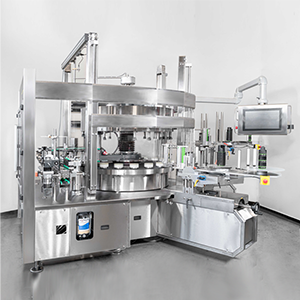
Pressure-sensitive labelers apply self-adhesive labels straight from the roll. No glue station, no glue to clean up, and very little label waste. That simplicity is why pressure-sensitive labeling has become the default for so many food, beverage, personal care and pharma lines.
On a GERNEP rotary labeler, pressure-sensitive stations can apply front, back and wrap-around labels on glass, PET, plastic and other containers, in round or shaped formats. One machine can be set up to run a wide range of products, label sizes and container formats, so a new SKU doesn’t mean a new labeler. Changeovers come down to swapping format parts and loading a new label roll.
Options include a non-stop function that keeps the line labeling through a reel change, and camera-based orientation that positions each container before the label goes on, so placement stays consistent at production speed.
Best for: Multi-SKU lines, premium or clear “no-label look” labels, and plants that want less glue maintenance.
Hot Melt Rotary Labelers
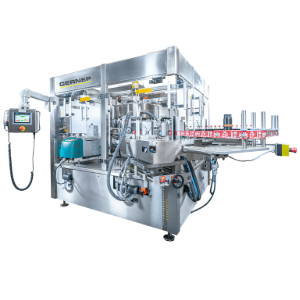
Hot melt labelers apply wrap-around labels using molten adhesive that sets within seconds. On rollfed machines, the label comes off a reel, is cut to length, and gets glue only at the leading and trailing edges. The result is a full 360° wrap with very little adhesive.
GERNEP builds hot melt rotary labelers in two formats: rollfed (labels from the roll) and cut-and-stack (pre-cut labels from a magazine). Both handle glass, PET, aluminum and plastic containers, round or square. For high-volume products that need a complete wrap, hot melt is generally the most economical labeling method per unit.
Options include camera-based orientation and label inspection, plus dating and coding to print lot codes and best-before dates on the line.
Best for: High-volume beverage, water and edible oil lines that need full wrap-around labels at low cost per label.
Cold Glue Rotary Labelers
Cold glue (wet glue) labelers apply pre-cut paper labels from a magazine, using a water-based adhesive at room temperature. No heat touches the container. That makes cold glue the safe choice for heat-sensitive materials and for lines where containers come off the filler cold, wet or covered in condensation.
On GERNEP rotary labelers, cold glue stations apply front, back, shoulder and neck labels, plus tamper-evident seals, tax strips and metal foil. Several cold glue stations can run on the same machine. In GERNEP’s references, a Labetta labeler with two cold glue stations runs at 12,000 containers per hour.
Options include mechanical and photo-electronic container alignment, camera-based orientation and tamper-evident cap labeling.
Best for: Beer, wine and spirits, dairy and other lines with cold or wet containers, paper labels or multi-label decoration.

Combination Labelers & the Flectra
Some products need more than one labeling technology, for example a self-adhesive body label with a cold glue neck label. Instead of running two labelers in a row, a GERNEP combination labeler puts several technologies on one rotary machine. Wet glue, hot melt and self-adhesive stations can run separately or together.
One GERNEP reference, a German wine cooperative, runs two combination rotary labelers. Each has two cold glue units and three pressure-sensitive dispensers, with output from 1,500 to 13,000 bottles per hour depending on the product.
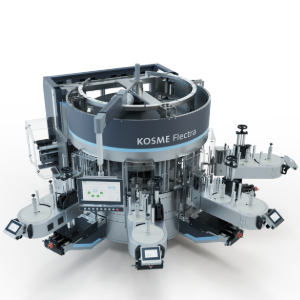
Flectra is the newest machine in this lineup, developed jointly by GERNEP (now KOSME Germany) and KOSME Italy. It comes in two designs: pre-modular and fully modular. On the fully modular version, labeling stations roll in and out on trolleys and set their main parameters automatically, so switching label formats takes a fraction of a full changeover. Flectra currently offers self-adhesive and cold glue labeling stations, optical alignment and label inspection, and a smaller footprint than earlier generations. It’s built for low- and medium-output lines in beverage, liquid food, personal care and pharma.
GERNEP, KOSME and Krones: Who’s Behind the Machine
If you’ve seen both “GERNEP” and “KOSME Germany” on a spec sheet, they’re the same company.
GERNEP spent decades building rotary labelers in Germany before joining Krones AG in 2015. Krones is one of the world’s largest makers of filling and packaging lines. GERNEP became part of Krones’ Compact Class, the division that focuses on machines for low- and medium-output lines, alongside its sister companies KOSME Italy and KOSME Austria.
In 2025, Krones began bringing these companies together under the KOSME name. GERNEP GmbH is now KOSME Germany GmbH. The first result of that merger is the Flectra, a new-generation labeler designed jointly by the German and Italian engineering teams.
What this means for you:
- Same engineering team. The people who designed your GERNEP labeler are still the ones building it.
- Krones behind it. You’re buying from a manufacturer backed by one of the biggest names in packaging, not a niche shop that could disappear in five years.
- Long-term machine support. Existing GERNEP models remain available to order and so will parts support for legacy models.
- A local point of contact. In Quebec, you deal with Link Pack, in English or French.
Service & Support for GERNEP Labelers in North America
Your first call is Link Pack: same time zone, English or French. Our technicians are trained by GERNEP, so the person answering your call knows your machine.
The Kosme factory is six hours ahead, but support doesn’t have to feel far away. GERNEP technicians diagnose and fix many issues remotely, checking your machine’s controls and settings without waiting for someone to fly in. When a part is needed, it ships express from a large stock in Germany. Every machine includes on-site start-up and operator training. Inspection contracts, format conversions and full overhauls keep your labeler running long after the warranty ends.
Frequently Asked Questions
Automatic Rotary Labeling Machines in Canada
What is a rotary labeling machine?
A rotary labeler takes containers off the conveyor onto a turning carousel. Labeling stations apply labels while the container rotates. Several containers are labeled at once, which is why rotary machines reach higher output than linear labelers.When should I switch from a linear to a rotary labeler?
Switch when your target speed passes what your linear labeler can hold without losing placement accuracy, or when you need several labels and label types applied in one pass. For many lines, that point is around 100 labels per minuteWhat’s the difference between cold glue, hot melt and pressure-sensitive labeling?
Cold glue suits paper labels, heat-sensitive containers and wet or humid conditions. It’s common for front, neck and tamper-evident labels.
Hot melt is the economical choice for high-volume wrap-around labels on glass, PET, aluminum and plastic.
Pressure-sensitive (self-adhesive) labels come on rolls and produce little waste, which makes them a good fit when you run varied products.Can one GERNEP machine apply more than one label type?
Yes. GERNEP can combine two or more labeling technologies on the same rotary labeler. A common example is a self-adhesive body label with a cold glue neck or tamper-evident label.Who sells and supports GERNEP labeling machines in Canada?
Link Pack, based in Terrebonne, Quebec, distributes GERNEP rotary labelers in Canada, with bilingual sales and integration support.
See Gernep Rotary Labelers in Action
Cold glue, hot melt and self-adhesive. Alone or combined.
Gernep Rotary Labeler for front & back label application on plastic bottles
Gernep hot melt cut & stack labeler for edible oil
Liebhart Brewery Labetta Front Back Tamper Evident Neck
Kosme Flectra
Rotary PS Labler for body and neck on beer bottles
Gernep hot melt rollfed labeler for edible oil
Outgrowing Your Linear Labeler?
Send us your container, your label and your target speed. We’ll tell you whether rotary makes sense, and which GERNEP configuration fits.
Talk to Our Team