

Beyond the Fill Line
Why Canadian Plant Managers Are Rethinking Drum & IBC Filling Operations
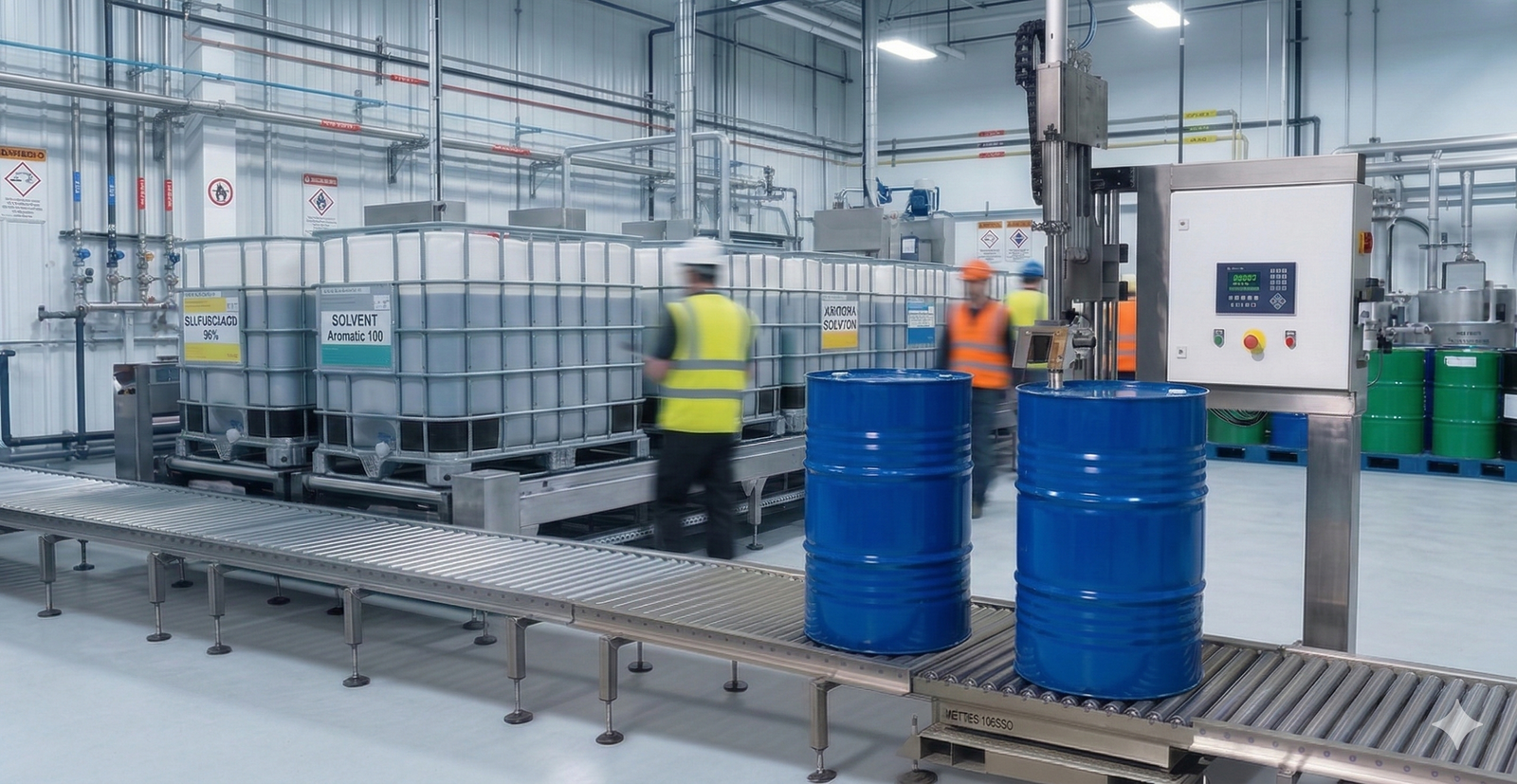
For Canadian plant managers running high-volume liquid operations, the filling line rarely gets the strategic attention it deserves. Canisters, pails, 200L drums, totes, and IBCs move product out the door every shift. So as long as they’re moving, the assumption is that everything is working, but that assumption is quietly costing you. From Chemical Valley in Sarnia to the petrochemical corridors of Fort Saskatchewan, from food processors in the Greater Toronto Area to agrochemical distributors across the Prairies, the gap between what automated drum and IBC filling equipment can deliver and what manual or semi-automated systems actually produce is widening every year. Labor costs are climbing. Regulatory scrutiny is tightening. Product giveaway accumulates fill after fill. And competitors who have already modernized their bulk liquid filling operations are pulling ahead. Understanding, specifically, where your current filling line is working against you is the best way to invest in a more impactful way.
The Hidden Cost Buried Inside Your Filling Line
The most dangerous inefficiencies in industrial liquid filling are the ones that never show up as a line item. They are distributed across labor budgets, product yield reports, incident logs, and maintenance schedules: invisible in isolation, significant in aggregate.
1. Labor Dependancy Is a Structural Problem, Not a Staffing On
Manual drum filling and semi-automated IBC filling are labor-intensive by design. For Canadian facilities, that dependency has become increasingly expensive. The skilled trades shortage is not a short-term disruption, it is a structural shift. Facilities that rely on operators to manually position, fill, bung, and move 200L drums or 1,000L totes are not just absorbing today’s labor costs. They are building those costs permanently into their unit economics.
Automated drum filling machines and IBC filling stations eliminate the fill-and-monitor cycle entirely, freeing operators for higher-value work while maintaining consistent throughput regardless of shift composition or staffing levels.
2. Regulatory Exposure Grows With Every Manual Touchpoint
Liquid handling in Canada, particularly for chemical, agricultural, and petroleum products, is governed by a dense framework of federal and provincial requirements. Manual processes introduce variability at every touchpoint: inconsistent seals, missed spill containment steps, improper fill levels, and exposure risk during the transfer of hazardous materials.
Automated bulk liquid filling systems engineered for hazardous environments, including explosion-proof drum fillers and ATEX-compliant IBC filling stations, remove the human variable from the most dangerous steps. They also generate the fill records, batch data, and weight verification documentation that regulators increasingly require.
3. Product Giveaway Is a Quiet Profit Leak
Overfilling a 200L drum by even 0.5% seems trivial. Across 500 fills per day over 250 operating days per year that margin erosion becomes substantial. Underfilling, meanwhile, risks customer disputes, regulatory non-compliance on net weight labeling, and potential product recalls.
Gravimetric drum filling systems with integrated load cell platforms and automatic tare/gross weight verification eliminate this variability. Fill accuracy of ±0.1% of full scale is achievable and repeatable across every container, every shift, without operator intervention.
4. No Data Means No Optimization
Most traditional drum and tote filling operations run without meaningful real-time data. Throughput, fill accuracy, downtime, and maintenance signals exist only as lagging indicators often discovered after the fact, if at all. This data gap makes it nearly impossible to identify subtle inefficiencies, anticipate equipment failures, or build a credible case for process investment.
Modern IBC and drum filling equipment integrated with plant SCADA or MES systems changes this entirely. IIoT-connected filling lines provide live visibility into every fill parameter, enabling predictive maintenance, batch traceability, and genuine continuous improvement.
Automated Filling Solutions for Every Container Format
Aicrov designs and supplies industrial liquid filling systems for the full range of container formats in Canadian production environments, from small-volume canisters through to large-format IBCs and totes. Each system is engineered to deliver measurable gains in accuracy, throughput, safety, and operational intelligence.
Small-Format Filling: 20L Canisters and Pails
For high-speed canister and pail filling lines, Link Pack deploys Aicrov’s advanced volumetric and gravimetric systems using piston, time-pressure, flow meter, or high-resolution load cell technology. Fill accuracy to within fractions of a gram or millilitre is standard. Integrated robotic pick-and-place, capping, and labeling modules reduce manual handling, and tool-less changeover mechanisms minimize downtime between SKUs or container formats.
Drum Filling Machines: 200L Drums & 55-Gallon Barrels
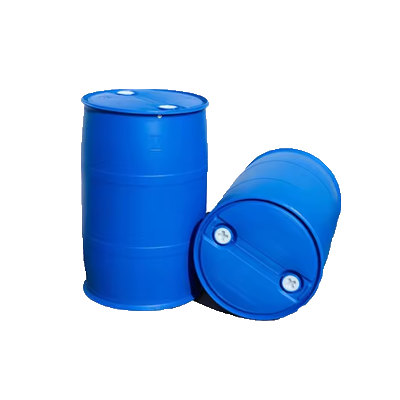
Automated drum filling is where many Canadian facilities see the fastest and most quantifiable return. Aicrov’s drum filling machines are designed for both top-fill and sub-surface filling configurations, accommodating non-foaming and foaming liquids, as well as inert gas blanketing for sensitive or reactive products.
Key capabilities include:
- Configurable filling lances for top-fill and sub-surface fill applications
- Integrated load cell platforms with automatic tare, gross weight verification, and net weight compliance
- Automated pneumatic or robotic bunging and capping for leak-proof seals
- Explosion-proof components and intrinsic safety barriers (ATEX, IECEx, NFPA) for hazardous liquid environments
- Integrated fume extraction and spill containment systems
For facilities in Sarnia, Fort Saskatchewan, or any petrochemical or chemical processing environment, hazardous-area-compliant drum filling equipment is not optional; it is a baseline requirement that Aicrov systems are built to meet.
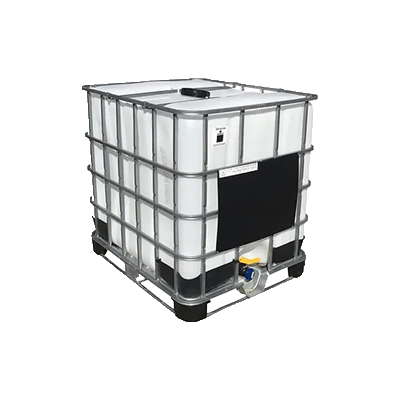
IBC and TOTE Filling Systems : 500 – 1,500+ L
Large-format IBC and tote filling represents the highest-stakes filling operation in most facilities. The volumes involved amplify every error, overfill, contamination, improper sealing; and the logistics of moving filled IBCs through a plant without automated conveyance creates both bottlenecks and safety hazards.
Aicrov’s IBC filling systems are built around high-capacity gravimetric platforms capable of ±0.1% accuracy at full scale, with seamless integration into automated pallet conveyance systems to reduce forklift traffic and improve plant flow.
Additional capabilities include:
- Aseptic filling heads for dairy, pharmaceutical, and food-grade applications, reducing cold chain dependency by up to 20–30% in relevant use cases
- Multi-product CIP (Clean-in-Place) capability for rapid changeover between product runs
- IIoT connectivity to SCADA and MES platforms for real-time batch records, fill parameter monitoring, and predictive maintenance alerts
- Modular architecture designed for future scalability as throughput demands grow
Why This Matters Now for Canadian Industrial Operations
The economic and regulatory environment in Canada is not getting simpler. Labor availability is constrained and unlikely to recover to pre-2020 levels in most industrial markets. Environmental and workplace safety standards for liquid handling are being tightened at both the federal and provincial level. And customer expectations for batch traceability and documentation particularly in food, pharmaceutical, and chemical supply chains are increasing.
Facilities that modernize their drum filling and IBC filling operations now are not just solving today’s problems. They are building the operational infrastructure that will be required to compete in this market over the next decade!
The question for most Canadian plant managers is no longer whether to automate bulk liquid filling operations. It is how quickly the transition can be executed, and which system architecture best fits the specific container formats, products, and throughput demands of their facility.
Link Pack works with plant managers across Ontario, Quebec, Alberta, and British Columbia to specify, integrate, and commission Aicrov’s automated drum and IBC filling systems to deliver measurable ROI from day one. Whether the priority is reducing labor dependency, achieving hazardous area compliance, eliminating product giveaway, or gaining real-time operational visibility, the right filling system is a direct path to all four
FAQ: Drum Filling & IBC Filling Equipment in Canada
Where can I source automated drum filling machines in Canada?
Aicrov supplies and integrates automated drum filling machines for Canadian industrial facilities, with expertise in hazardous-area compliance, gravimetric accuracy, and integration with existing plant systems. We serve customers across Ontario (including Sarnia, Hamilton, and the GTA), Quebec, Alberta, and British Columbia.
What is the difference between a drum filler and an IBC filling system?
A drum filler is designed for 200L (55-gallon) containers and typically incorporates a filling lance, integrated weighing platform, and automated bunging. An IBC filling system handles larger intermediate bulk containers (500–1,500L totes) and generally requires higher-capacity gravimetric platforms, automated conveyance integration, and more sophisticated IIoT connectivity for batch management.
Are Aicrov filling systems compliant with Canadian hazardous material regulations?
Yes. Aicrov drum and IBC filling systems designed for hazardous liquid environments are engineered with explosion-proof components and intrinsic safety barriers compliant with ATEX, IECEx, and NFPA standards, meeting the requirements of Canadian federal and provincial workplace safety regulations for handling flammable, corrosive, and toxic liquids.
The Strategic Re-Evaluation Starts at the Fill Point
Liquid filling is not a back-of-house operation. It sits at the intersection of production efficiency, product quality, regulatory compliance, and safety performance. For Canadian plant managers, the filling line is one of the highest-leverage points in the entire production system, and one of the most under-optimized.
Aicrov’s automated drum filling and IBC filling solutions are not a cost centre. They are a precision instrument for reclaiming margin, protecting personnel, and building an operation that can scale with confidence. If your current filling line is holding you back, it’s time to look beyond the fill line.
Contact Link Pack to discuss your drum filling or IBC filling requirements. We serve industrial facilities across Canada with engineered filling solutions built for your products, your containers, and your operational environment.
