


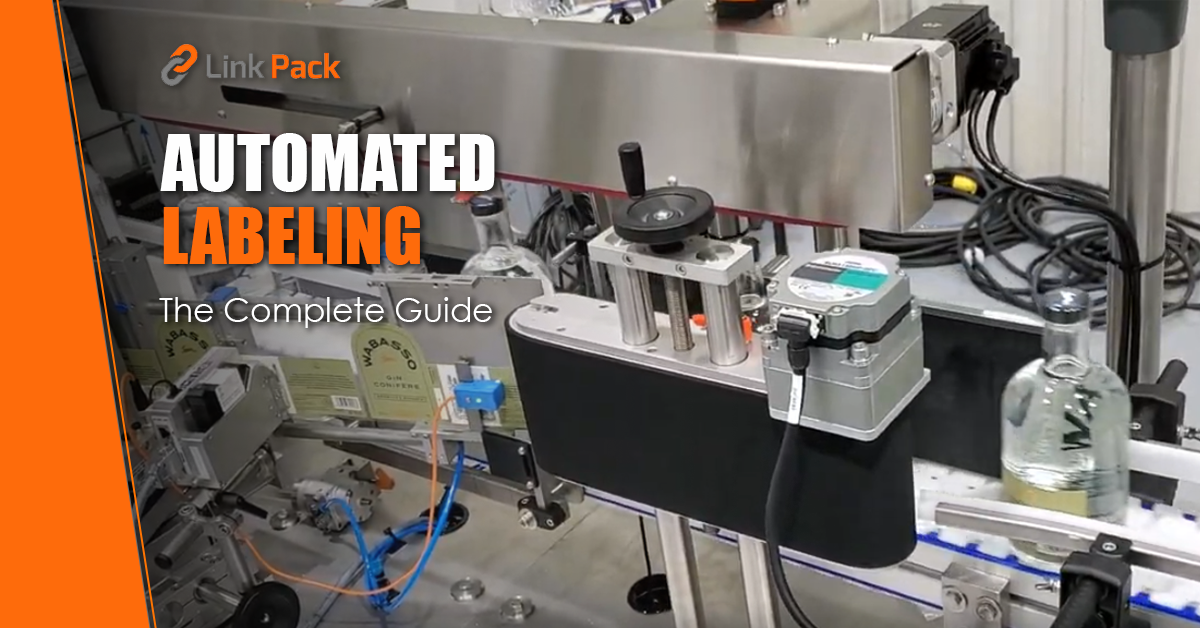
Automated Linear Labeling Machines: The Complete Guide for Manufacturers in Canada & the USA
Stainless steel construction, quality components, built to last, and backed by local Canadian service.
Everything manufacturers in Canada and the USA need to know before buying.
A automatic linear labeling labeling machine is one of the hardest-working pieces of equipment on your packaging line. It runs every shift, handles every SKU, and touches every unit that leaves your facility. Get it right and it disappears into your operation. Get it wrong, wrong build quality, wrong components, wrong service model, and you’ll be managing it instead of running your line. This guide is written for Canadian and US manufacturers who want to buy once, buy right, and have a machine that’s still performing a decade from now.
- What is an automated linear labeling machine?
- Types of automated labeling machines
- Container compatibility table
- Speed & throughput reference table
- Industry applications
- Linear vs. rotary: how to choose
- What specs actually matter when buying
- CSA certification: what Canadian manufacturers need to know
- What makes a labeling machine worth owning long-term
- Frequently asked questions
1. What is an Automated Linear Labeling Machine?
An automated linear labeling machine applies pressure-sensitive (self-adhesive) labels to products as they travel in a straight line along a conveyor. The machine controls container spacing, orientation, and label placement without manual intervention; consistently, at production speed, container after container. “Linear” refers to how containers move through the machine: in a straight, single-file line. They distinguishes temselves from rotary labelers, which move containers on a circular carousel for simultaneous, higher-speed processing. For the vast majority of Canadian and US manufacturers running multiple SKUs or mid-range volumes, a linear labeler is the right tool — more flexible, easier to maintain, and significantly easier to changeover between products.
Linear labelers make up approximately 50% of all labeling machines sold in North America — far outpacing rotary systems, which account for only 3–5% of total market volume. They dominate because they serve the widest range of manufacturers and the widest range of containers: from standard bottles and cans to pails, pouches, tubes, and even irregular or non-standard surfaces. Link Pack has engineered linear labeling solutions for virtually every container type — including a prototype cobot-assisted system capable of applying labels with precision into concave or extruded product surfaces that no conventional labeling machine can reach.
A well-specified linear labeler will handle your containers, apply your label accurately every time, and integrate cleanly with the rest of your packaging line — without a six-figure price tag or a 12-month installation project.
2. Types of Automated Labeling Machines
Not all linear labelers do the same job. The type you need depends on your container shape, how many label faces you need to apply, and where on the container the label goes.
Front & back labelers
Apply two labels simultaneously to opposite faces of a container. Ideal for rectangular bottles, jars, or containers that require both a product-facing label and a regulatory/nutrition panel on the back. Common in food, pharma, and natural health products.
Top labelers
Apply a flat label to the top face of a container — lids, clamshells, pails, trays, or flat packages. Often used in food service, produce, and industrial applications. Can also be configured with a print head for variable data (lot codes, best-before dates).
Top & bottom labelers
Apply labels to the top and bottom of a container simultaneously as it passes through the machine. Common accross industries manufacturing CPG products requiring labeling on both faces.
Side labelers (single or dual side)
Apply labels to one or both flat sides of square or rectangular containers. Common in industrial, household cleaning, and chemical packaging.
Wrap labelers
Apply labels that wraps partially or completely around a cylindrical container. These are very common on round bottles, jars, and cans in the food, beverage, cosmetics, and chemical industries.
Pail & bucket labelers
Specialized linear labelers designed for the geometry of pails, buckets, and large-format containers. Container handling (feeding, orientation, exit) is engineered for heavy, non-standard shapes. Link Pack fabricates pail labelers for coatings, food service, and industrial applications.
Pouch & bag labelers
Apply labels to flexible packaging — flat pouches, stand-up pouches, bags. These require specialized conveying to stabilize the flexible container during label application. Commonly used in cannabis, snack food, pet food, and personal care.
Excise stamp / tax stamp or tamper evident labelers
Apply government-mandated excise, tax stamps or tamper evident labels to regulated products in the cannabis and alcoholic beverage market, applying federally required stamps to pre-roll tubes, pouches, and bottles with the precision regulatory compliance demands. These labelers can also apply tamper evident labels to any consumer product which requires a safety seal.
3. Container Compatibility by Labeler Type
Use this table to match your container to the labeler configuration you need.
Container Type
Wrap
Front & Back
Top
Top & Bottom
C, U or L position
Side
Multi-Panel
Pouches & Bags
—
—
—
—
—
—
Clamshells & Deli Tubs
—
—
✔
✔
✔
—
—
Bottles & Jars
✔
✔
✔
✔
✔
—
✔
Tubes
✔
✔
—
—
✔
—
—
Aluminum Cans
✔
✔
✔
—
—
—
—
Pails & Buckets
✔
✔
✔
✔
✔
—
—
Boxes
—
✔
✔
✔
✔
✔
✔
4. Speed & Throughput Reference
Speed requirements are one of the most common mismatches between what a manufacturer buys and what they actually need. The right labeler isn’t the fastest — it’s the one that matches your line speed, your upstream filler, and your downstream packing station without creating a bottleneck.
Production Volume
Speed Range
Machine Format
Low volume / small batch
20–40 units/min
Automatic linear labeler
Link Pack
Mid-range production
40–100 units/min
Automatic linear labeler
Link Pack
High volume production
100–300+ units/min
Automatic Rotary Labeler
5. Industry Application for Automated Labelers
Link Pack’s fabricated linear labelers are deployed across a wide range of industries. Below are the most common applications we build for.
6. Linear vs. Rotary Labeling Machines
The choice between a linear and rotary labeler comes down to volume, SKU count, and budget. Here’s an honest breakdown — including when to consider the Gernep rotary labelers that Link Pack distributes across Canada and the USA.
Criteria
Linear Labelers
Rotary Labelers
Speed
Up to 100 containers/min
100+ containers/min
SKU Flexibility
Easy changeover across container sizes
Change parts typically required per format
Container Variety
Handles flexible packaging as well as rigid conainers
(bottles, bags, cans, jugs, jars, pails, pouches, and etc.)
Handles rigid packaging only
(bottles, cans, jugs, jars, pails, and etc.)
Footprint
Compact – fits into most existing lines
Compact to large – planning for retrofit is required
Ideal for
Small to large businesses with moderate production speeds
Mid to large businesses with high speed production requirements
Available from Link Pack
Fabricated in Qc, Canada
Distributed across Canada & USA
If you’re running a high-volume, single-SKU line like a craft brewery scaling to regional distribution or a dairy co-packer labeling millions of units per week — a Gernep rotary labeler may be the right answer. Link Pack distributes Gernep rotary labelers across Canada and the United States, and can help you specify the right system for your throughput requirements. Learn more about Gernep rotary labelers here.
For the majority of manufacturers with multiple SKUs, varied container formats, mid-range throughput, a well-built linear labeler will outperform a rotary on flexibility, cost, and ease of operation.
7. What Specs Actually Matter When You’re Buying a Labeler?
Spec sheets can be confusing by design. Here are the considerations that genuinely determine whether a machine works for your line, and the ones that are mostly marketing.
Container range (diameter & height)
The minimum and maximum container diameter and height the machine can handle. This is essential, if your container falls outside this range, some OEMs may offer to customize the equipment. Always confirm your smallest & largest sizes & send samples for testing.
Label size range
The minimum and maximum label dimensions the machine can apply. Confirm this against your largest and smallest label across all SKUs, not just your primary product.
Label placement accuracy (registration tolerance)
Expressed in ±mm. This tells you how precisely the label will be positioned on each container. For most food and industrial applications, ±1mm is acceptable. For pharma, cannabis, and premium cosmetics, you want ±0.2mm or better.
Line speed (containers per minute)
Match this to your filler speed, at least, but plan to have room for growth. A labeler rated at 150 CPM running at 80 CPM is fine because you have headroom.
A labeler only approximating your current speed is bottleneck waiting to happen, and it will cost you.
Label roll diameter & core size
Larger label rolls mean less frequent changeovers. For example Having the option to upgrade to a 24″ outer diameter vs more standard 12″. It is also worth noting that both linear & rotary labelers can house “redundant” labeleing, which means when one applicator runs out of labels another applicator automatically picks up – avoiding any downtime at all. Always confirm core & ext diameter with your OEM & label supplier; a mismatch between the machine’s roll spec and your label supplier’s standard roll will cause constant interruptions.
Changeover time
Often overlooked. If you run multiple SKUs, changeover time per format change directly impacts your effective capacity. Ask for a demo changeover, not just a quoted time. The difference between 2 minutes and 20 minutes per changeover is enormous across a week of production.
What to be aware of
Theoretical maximum speed is always an evaluation under ideal circumstances. An evaluation of actual containers & label stock is strongly suggested. Most OEMs will suggest running a demo to evaluate behavior and actual possible throughput. Always request this before committing.
8. CSA Certification: What Canadian Manufacturers Need To Know
If you’re purchasing packaging machinery for use in Canada, CSA (Canadian Standards Association) certification is not optional, it’s a legal and insurance requirement for industrial electrical equipment in Canadian manufacturing environments.
Many labeling machines sold into Canada are manufactured in Europe or Asia and carry CE or UL marks, which are not equivalent to CSA certification. Importing a non-CSA machine means one of two things: either the machine requires field certification by a licensed Electrical Safety Authority inspector (expensive, time-consuming, and not guaranteed to pass), or it can’t legally be put into production in most Canadian provinces.
Every labeling machine fabricated by Link Pack in Quebec is built with stainless steel construction and quality components selected for industrial durability, and every machine is CSA certified. There are no field modification costs, no certification delays, and no insurance complications. The machine arrives ready to plug in, commission, and run. built to last, in full compliance with Canadian electrical safety standards, and backed by a local service team that speaks your language.
For US buyers, Link Pack’s machines also meet UL 508A control panel standards, making them compliant for deployment across the United States. If you’re purchasing for cross-border operations or a facility that spans both countries, Link Pack machines work on both sides of the border without modification.
9. What Makes a Labeling Machine Worth Owning Long-Term
Speed of delivery matters when your line is stopped and you need a machine now. But the decision that costs manufacturers the most money isn’t a slow delivery, it’s a machine that wasn’t built to last, supported by a supplier who’s hard to reach when something goes wrong.
Build quality starts with the frame
Link Pack fabricates its linear labelers on welded stainless steel frames with full safety guarding and interlocks; built to industrial standards, not to a price point. Stainless construction matters in food, chemical, and coatings environments where washdowns, humidity, and chemical exposure are a daily reality. An aluminum or painted mild steel frame that looked fine at installation looks very different after two years on a production floor.
Component selection: the difference between a machine and a platform
Most labeling machines, regardless of origin, use standard industrial components for drives, sensors, and pneumatics. The meaningful difference is which standard components a builder chooses, and whether those components are recognized and supported across North America.
Link Pack specifies by name: Allen-Bradley or Shneider PLC and HMI for machine control, Festo pneumatics, Keyence or Sick sensors, Herma 500 label applicators, and Oriental Motors. These are not generic substitutes, they are the benchmark components in North American industrial automation. Every one of them is stocked by local distributors across Canada and the United States. If something needs replacing on a Tuesday morning, your maintenance team isn’t waiting on an international shipment. They’re calling their local automation supplier.
The Practical Difference
Where sourcing becomes a real problem is format-specific tooling and change parts, the guides, star wheels, holders, and application heads machined for your container geometry. These are unique to your machine configuration regardless of who built it. With Link Pack, those parts are sourced from the Quebec team that fabricated your machine, not from an overseas OEM with extended parts lead times and a support queue that doesn’t know your line.
After-sale service: local means something different here
Link Pack’s bilingual (English and French) service team is based in Quebec and operates across Canada. When something needs attention, you’re talking to a technician who built the machine, not a call centre routing your ticket to a field team scheduled 3 weeks out. Remote-first support, on-site when needed, with no layers between you and the person who knows your equipment.
On delivery
OEM lead times for new labeling machines in Canada and the USA currently run 16 to 52 weeks. Link Pack fabricates in Quebec and new builds generally run 16-24 weeks max., they also maintains an in-stock inventory of machines that ship within approximately one week.
10. Frequently Asked Questions
Find The Right Labeling Machine For Your Line
Whether you need a fabricated linear labeler built in Quebec, a high-speed Gernep rotary system, or a machine that ships in days, we can help you spec the right solution for your container and your throughput.
